On this page
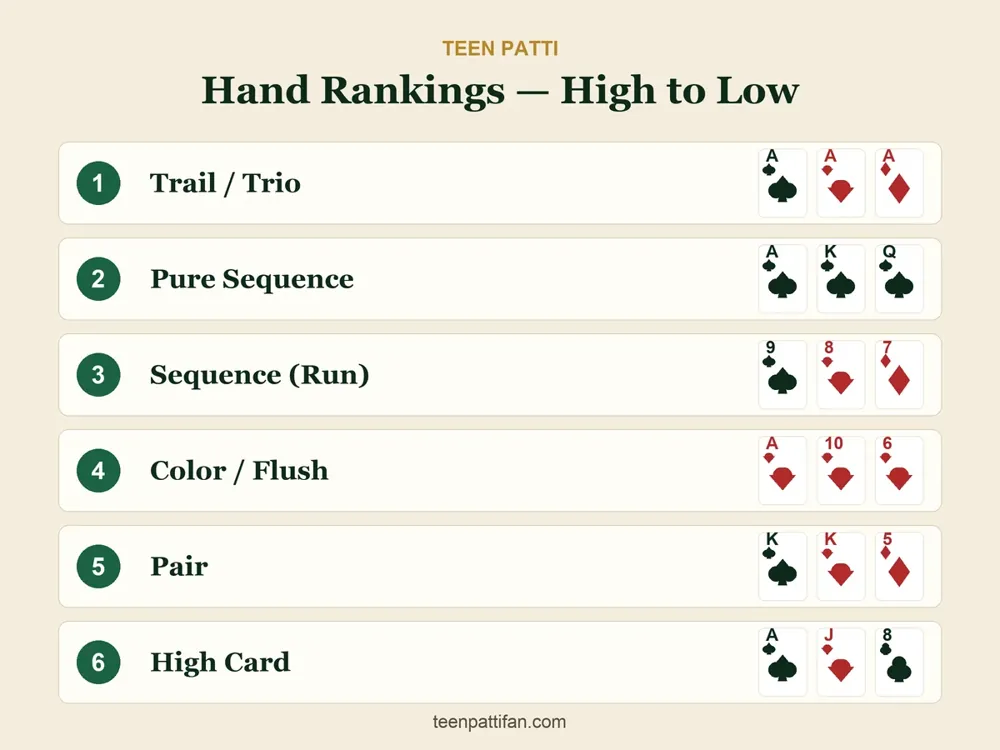
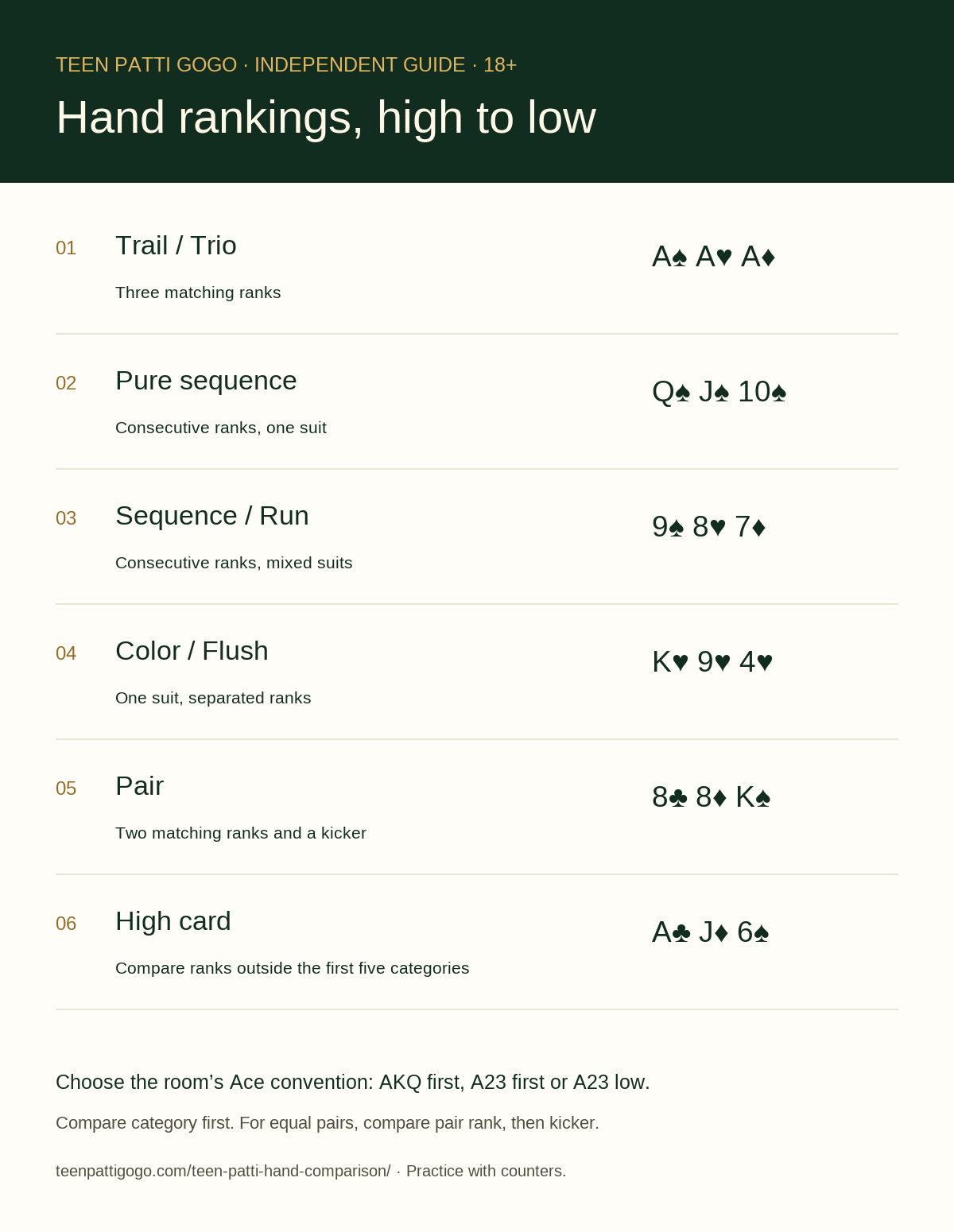
The standard order is Trail → pure sequence → sequence → color → pair → high card. Compare category first, then ranks and the table’s Ace convention.
Which hand is highest?
In the standard non-joker game, Trail is the strongest category, followed by pure sequence, sequence, color, pair and high card. The word “sequence” is also used casually for the whole ranking list. A true sequence means three consecutive ranks, while a pure sequence also shares one suit.
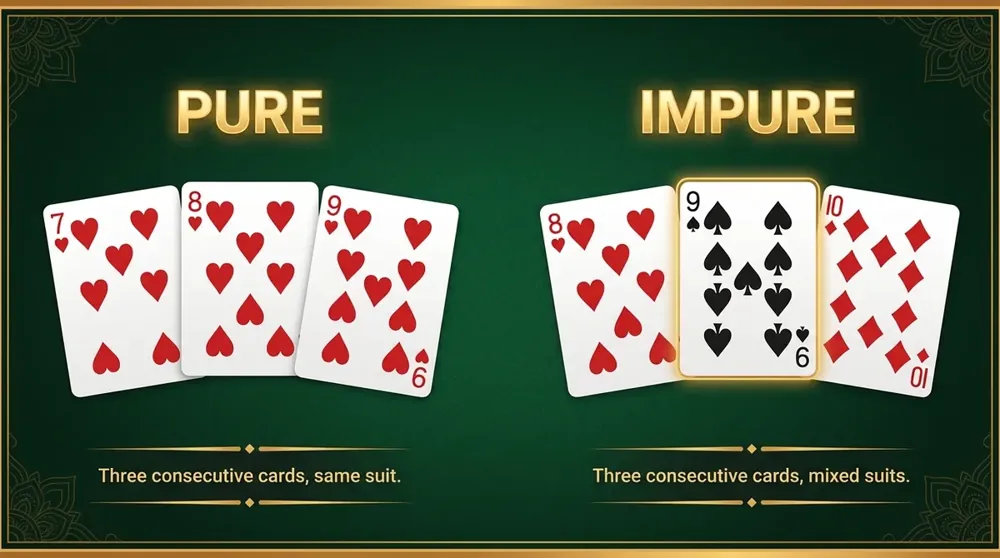
Pure sequence versus sequence
Q♠ J♠ 10♠ is a pure sequence because every card is consecutive and spades. Q♠ J♥ 10♦ is a sequence with mixed suits. Any pure sequence beats any mixed-suit sequence in this convention, even if the mixed-suit sequence has higher individual cards.
A♠ J♠ 6♠ is color: all three cards share a suit and have separated ranks. A♥ K♣ 2♦ is a high-card example: ordinary sequence rules place the Ace at an end.
How to settle a tie
Start with the category. If both players have pairs, compare the pair rank, then the unmatched kicker. Q-Q-4 beats J-J-A. If both have color or high card, compare the highest card, then the next, then the last. Identical ranks can produce a tie; follow the table’s published tie rule rather than inventing a suit hierarchy.
A-K-Q or A-2-3?
Both can be valid. Their relative strength is a house rule. One published Octro reference puts A-2-3 first, while another describes A-K-Q first. This chart therefore identifies the Ace order as a table convention. Confirm it inside the app or before dealing.
Try these three comparisons
Pair of threes versus Ace-high: the pair wins. Mixed-suit 5-4-3 versus A-J-8 of one suit: the sequence wins. J-J-9 versus J-J-7: the nine kicker wins. These comparisons use the standard category order and ordinary cards. Muflis and joker variants need separate rules.
Three questions that settle the comparison
| Situation | Decision | Example |
|---|---|---|
| Different categories | Use the six-category order | 3-3-8 pair outranks A-J-6 high card |
| Equal pair ranks | Compare the unmatched kicker | Q-Q-9 outranks Q-Q-7 |
| Equal sequence categories | Apply the table’s Ace profile | A-K-Q versus A-2-3 |
| Equal comparison ranks | Use the agreed tie procedure | Equal ranks in different suits can tie |
Hand order and frequency
Ranking is a game convention; frequency counts the combinations in a deck. The standard order places Trail above pure sequence. The exact count model contains 52 Trails and 48 pure sequences, so frequency and rank order are distinct pieces of information. Read the 22,100-hand calculation for the complete category table.
Save a clean reference
Download the printable SVG chart for all six categories and the Ace reminder. For an individual comparison, choose six distinct cards in the hand tool. Its profile selector keeps the Ace convention visible beside the result.
Source references
Rule references identify the convention described by the publisher. File and product records retain their own source scope.