On this page
If you've searched "classic rummy", you almost certainly mean the traditional 13-card Indian rummy — the version played at family tables for generations and the default game on every rummy app. This guide keeps it focused: what classic rummy is, the rules in brief, how it differs from pool, points and deals, the strategy that actually wins hands, and the easiest way to start playing today.
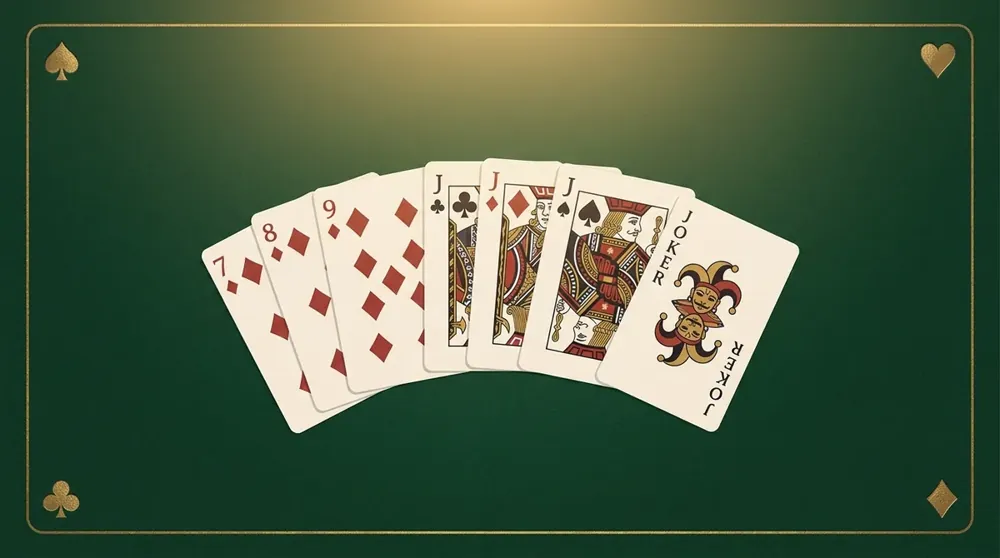
Keep the rankings close at hand
Review the six hand categories, Ace conventions and example comparisons in the complete ranking guide.
Open the hand-ranking reference →What Is Classic Rummy?
Classic rummy is the standard, traditional 13-card Indian rummy — the original form of the game from which every other variant descends. Two standard 52-card decks plus printed jokers are shuffled together, each player is dealt 13 cards, and the goal is to be the first to arrange all 13 into valid sequences and sets and declare. It's the version your grandparents played and the one that loads first when you open any rummy app.
You'll also notice that "Classic Rummy" is the name of a well-known rummy app/brand in India. That's worth knowing, but it can confuse things: in this guide we focus on the game — classic 13-card rummy — not any single operator. Once you understand the classic game, you can play it anywhere, on any platform, or with a physical deck at home.
Rummy combines shuffled cards with grouping, memory and discard decisions. Use practice counters to learn the format. For a service’s legal classification, read its actual terms together with the current national framework and other applicable requirements.
Classic Rummy Rules in Brief
Here are the essentials — enough to sit down and play. For the complete walkthrough with examples, read the full 13-card rummy rules .
- The deal. Each of the 2–6 players gets 13 cards. One card is turned up to start the open (discard) pile; the rest form the closed pile. One random card is chosen as the wild joker for the round.
- Your turn. Draw one card (from the closed or open pile), then discard one. You always hold 13 cards between turns.
- Pure sequence. Three or more consecutive cards of the same suit with no joker, e.g. 5♥ 6♥ 7♥. You must have at least one pure sequence to make a valid declaration.
- Impure sequence. A run that uses a joker (printed or wild) to fill a gap, e.g. 8♠ 9♠ Joker.
- Set. Three or four cards of the same rank, different suits, e.g. 7♥ 7♠ 7♦. Jokers can complete a set.
- Jokers. Printed jokers and the round's wild joker substitute for any missing card in impure sequences and sets — never in a pure sequence.
- Valid declaration. All 13 cards grouped, with at least one pure sequence and a second sequence (pure or impure); remaining cards in sequences or sets. Place a card on the finish slot and declare for zero points to win.
You cannot declare without a pure sequence. Even if every other group is perfect, a declaration missing a pure sequence is invalid and is penalised at full count (80 points). Build the pure sequence first — always.
Classic Rummy vs Pool, Points & Deals
People often ask how "classic rummy" relates to pool, points and deals rummy. The good news: the core 13-card rules are identical in all of them . What changes is the scoring and how long a game lasts. "Classic" usually refers to a single, self-contained game — most often played in points or deals form.
| Format | How it works | Best for |
|---|---|---|
| Classic / Points | One quick hand. Each point has a value; the winner takes the others' points. Fast and decisive. | Quick games, casual play, beginners. |
| Deals | A fixed number of deals (e.g. 2 or 3). Players start with set chips; the highest chip total at the end wins. | Short matches with a clear finish. |
| Pool (101 / 201) | Points accumulate across many hands. Cross 101 or 201 and you're eliminated; last player standing wins. See our pool rummy guide. | Longer, strategic sessions. |
| Tournaments | Multi-round knockout play across many tables. See our rummy tournament guide. | Competitive players chasing leaderboards. |
So "classic rummy" isn't a different game from these — it's the base game , usually in its simplest points or deals form. Master classic 13-card play and you can step into pool, deals or tournaments without learning anything new about the cards themselves. If you want the full Indian-rummy variant family, our sister guide on Ind rummy breaks them all down.
Classic Rummy Strategy: Win More Hands
Classic rummy rewards discipline more than daring. A handful of habits separate consistent winners from the rest:
- Pure sequence first, every time. Until you have a pure sequence, nothing else is safe — you can't declare without it. Prioritise it from your very first draw.
- Hold jokers for sets and impure runs. Jokers are wasted on a pure sequence. Save them to complete the hardest groups — usually sets or runs with a missing middle card.
- Read the discards. What opponents pick up and throw away tells you which suits and ranks they're chasing. Don't feed a card that obviously completes someone's group.
- Drop with discipline. If your opening hand has no pure-sequence potential and high deadwood, a first-turn drop costs far fewer points than a failed declaration. Knowing when to fold is a skill in itself.
- Shed high cards early. Unconnected K, Q, J and aces carry 10 points each. If they aren't forming a group, discard them before you get caught holding them.
None of this depends on luck — it's exactly why classic rummy is a game of skill. Practise these on free tables until they're automatic, and you'll win far more hands.
Where to Play Classic Rummy
Rummy combines shuffled cards with grouping, memory and discard decisions. Use practice counters to learn the format. For a service’s legal classification, read its actual terms together with the current national framework and other applicable requirements.
- On an app. Free and social apps such as Teen Patti Real give you the full classic 13-card game, practice tables, matchmaking, daily rewards and a welcome bonus — the fastest way to play anytime, anywhere.
- With a physical deck. Two decks, jokers and three to six players — the timeless way to enjoy classic rummy at home.
- Learn first if you're new. Lock in sequences, sets and the declaration with our Indian rummy rules , then play.
- Compare your options. Browse bonus-rich apps in our all rummy app list (51 bonus) before you download.
Keep the rankings close at hand
Review the six hand categories, Ace conventions and example comparisons in the complete ranking guide.
Open the hand-ranking reference →FAQ
What is classic rummy?
How do you play classic rummy?
What is the difference between classic rummy and pool rummy?
Is classic rummy a game of skill?
Where can I play classic rummy online?
Sources & references
- Indian rummy — the traditional 13-card game and its sequences, sets and joker rules.
- Rummy — the wider rummy family and how the classic draw-and-discard game works.
- Online game in India — the skill-game status that makes classic rummy legal to play.
External links open in a new tab and are provided for verification. We are an independent guide and are not affiliated with these sources.
Related Guides
Source references
Rule references identify the convention described by the publisher. File and product records retain their own source scope.