On this page
If you've seen the term "Ind Rummy" on an app store, a download page or in a friend's chat and wondered whether it's a new game, here's the reassuring answer: it isn't. Ind Rummy is just the short, app-style name for online Indian Rummy — the classic 13-card rummy that millions of people in India already play. Same cards, same sequences, same declaration. This guide explains the name, walks you through how to play, the main formats, why it counts as a game of skill, and the safest way to start on your phone.
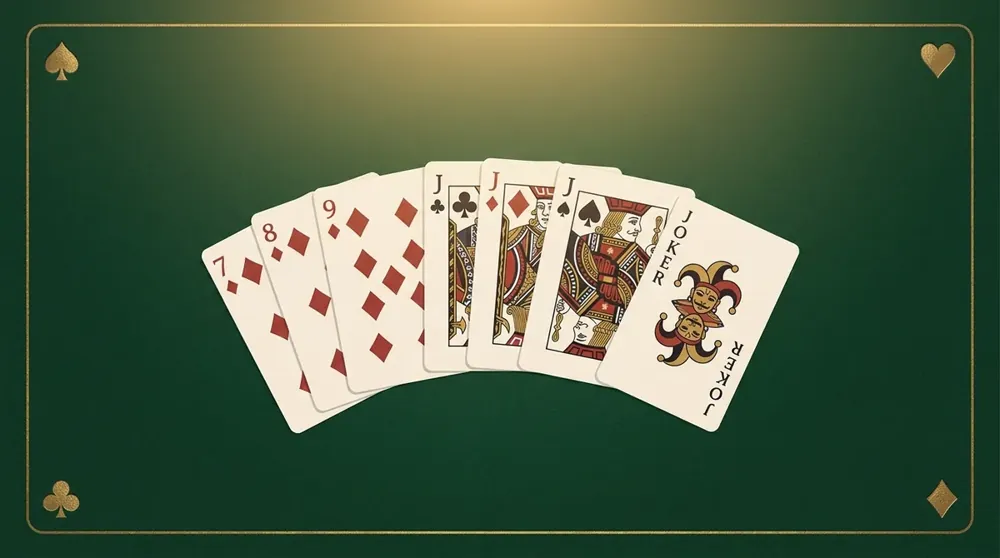
Keep the rankings close at hand
Review the six hand categories, Ace conventions and example comparisons in the complete ranking guide.
Open the hand-ranking reference →What Is Ind Rummy?
Ind Rummy is the common shorthand for Indian Rummy — the standard 13-card rummy game that is, by a wide margin, the most-played version of rummy in India. The name "Ind Rummy" took off because so many apps, stores and download listings squeeze "Indian Rummy" into a tighter label. So when you search ind rummy , indian rummy game or ind rummy app , you are all looking for the same thing.
The goal is simple: you are dealt 13 cards and you race to arrange every one of them into valid sequences and sets before your opponents do. It's played with two standard decks plus jokers (in the usual two-player-plus format), and a winning hand must include at least one pure sequence — a run of three or more cards of the same suit with no joker. Get all 13 cards grouped correctly, make a valid declaration, and you win the round.
Because it rewards memory, planning and reading your opponents, Ind Rummy is treated as a game of skill in India (more on that below). If you want the complete, rule-by-rule breakdown, our Indian Rummy rules hub covers every detail; this page keeps things focused on understanding the term and getting started fast.
"Ind Rummy", "Indian Rummy" and "13-card rummy" are three names for one game. There is no separate set of "Ind Rummy rules" — it's standard Indian Rummy, just with a shorter label.
How to Play Ind Rummy (13 Cards)
The flow of a hand is quick to learn and rewarding to master. Here's the short version — for the full rules, jokers explained and worked examples, see the 13-card Indian Rummy rules .
- The deal. Each player gets 13 cards . The remaining cards form the closed (draw) pile, and one card is flipped to start the open (discard) pile. A random card is also set as the wild joker for the round.
- Your turn. Draw one card — either the top of the closed pile or the top of the open pile — then discard one card. Your hand always stays at 13.
- Pure sequence. A run of three or more consecutive cards of the same suit, with no joker. You must have at least one to make a valid declaration.
- Impure sequence. A sequence that uses a joker (wild or printed) to fill a gap — allowed once your pure sequence is in place.
- Sets. Three or four cards of the same rank in different suits (e.g. three Kings). Jokers can complete sets too.
- Jokers. The printed jokers and the chosen wild-joker rank act as substitutes for any card you're missing — except inside a pure sequence.
- Valid declaration. When all 13 cards form valid groups — at least one pure sequence, a second sequence, and the rest in sequences or sets — discard to the finish slot and declare. A wrong declaration costs you the round.
New players win faster by forming the pure sequence first, then chasing sets, and by watching which cards opponents pick up and throw away. For more on that, read how to win at rummy .
Ind Rummy Formats: Points, Pool & Deals
Ind Rummy comes in three main formats. The cards and rules are identical — only the scoring and length of play change. Here's how they compare so you can pick the one that suits your time and mood.
| Format | How it works | Best for |
|---|---|---|
| Points Rummy | The fastest format — a single deal where each point carries a value. The winner scores zero; losers carry points for their unmatched cards. One round and it's done. | Quick games and short breaks |
| Pool Rummy | Played to a points limit (commonly 101 or 201). You accumulate points across deals, and a player is eliminated when they cross the limit. The last player standing wins. | Longer, more strategic sessions |
| Deals Rummy | A fixed number of deals (often 2 or 3). Players start each deal with equal chips; whoever has the most chips at the end wins. | Balanced, predictable game length |
If you're brand new, start with Points Rummy — one quick deal teaches you the whole flow without a long commitment. Once the sequences-and-sets habit clicks, Pool and Deals reward deeper planning. Want more rummy variants beyond these three? Our classic rummy guide covers the wider family, and the rummy hub ties it all together.
Is Ind Rummy a Game of Skill?
Grouping, memory and discard choices are useful parts of learning Rummy. An online service’s legal classification also depends on its actual stakes, rewards and operating model. Read the current national framework alongside those features.
Apply India’s national online game framework and the product’s actual classification. Read the primary references in the legal information guide.
Keep the rankings close at hand
Review the six hand categories, Ace conventions and example comparisons in the complete ranking guide.
Open the hand-ranking reference →How to Play Ind Rummy on Your Phone
Getting started takes a couple of minutes. Here's the safe, simple route:
- Install a trusted card-game app.Teen Patti Gold includes full 13-card Ind Rummy alongside Teen Patti, with matchmaking, daily rewards and a welcome bonus. Download the APK, allow the install, and open it.
- Start at a practice table. Free and practice tables let you learn the draw-and-discard rhythm with no pressure — perfect for getting the pure-sequence-first habit down.
- Learn the rules first if you're new. A quick read of the Indian Rummy rules and how to win at rummy will save you a lot of early mistakes.
- Compare your options. If you like exploring apps and bonuses, our all rummy app list with 51 bonus rounds up the popular choices.
- Keep it fun. Stick to free and social play, set a time limit, and treat Ind Rummy as entertainment — not a way to make money.
Keep the rankings close at hand
Review the six hand categories, Ace conventions and example comparisons in the complete ranking guide.
Open the hand-ranking reference →FAQ
What is Ind Rummy?
Is Ind Rummy the same as Indian Rummy?
How do you play Ind Rummy in 13 cards?
How can I play Ind Rummy on my phone?
Sources & references
- Indian rummy — the 13-card game that "Ind Rummy" refers to, its rules and formats.
- Rummy — the wider family of matching-card games and where Indian Rummy sits within it.
- Use the complete rule sheet to confirm the room’s counter limits and comparison convention. Follow one practice round, then revisit the matching rule section with the example cards face up.
External links open in a new tab and are provided for verification. We are an independent guide and are not affiliated with these sources.
Related Guides
Source references
Rule references identify the convention described by the publisher. File and product records retain their own source scope.